
The short answer: acoustic treatment controls how the room sounds inside. Soundproofing, which engineers call isolation, controls how much sound gets out, or in. They are different problems with different solutions. Every cinema needs treatment; whether it also needs isolation, and how much, depends on what's on the other side of the walls.
What acoustic treatment does
Put excellent speakers in an untreated room and you mostly hear the room. Treatment deals with three things.
1. Early reflections: why dialogue gets muddy
Sound from each speaker reaches you directly, then again a few milliseconds later after bouncing off the side walls, ceiling and floor. Those early reflections smear speech and blur where sounds seem to come from. Treating the reflection points, with absorption or diffusion placed exactly where the geometry says they are, is what makes dialogue clear at normal volume.
2. Decay: why some rooms sound harsh and others sound dead
Hard surfaces such as marble, glass and plaster keep sound bouncing around long after it should have stopped, and the room sounds bright and tiring. Cover everything in absorption and it swings the other way: flat and lifeless. The goal is a controlled, even decay, which usually means a mix of absorption and diffusion, not one material everywhere.
3. Bass: why it booms in one seat and vanishes in the next
Low frequencies form standing waves, called room modes, set by the room's dimensions. In some seats they pile up into a boom; in others they cancel almost to nothing. A bigger subwoofer doesn't fix this, because it just excites the same modes harder. What fixes it is proportion, seat and subwoofer placement, often multiple subwoofers, proper low-frequency treatment, and then measurement and correction.
Why foam doesn't fix it
Thin foam panels absorb the high frequencies and do very little to the low ones that actually ruin a room. Put up enough of them and the room loses its sparkle while the bass problems stay exactly where they were. Low-frequency control needs depth, mass or tuned treatment, designed for the frequencies your room has trouble with.
What soundproofing (isolation) does
Isolation stops the film from waking the house, and stops the house from interrupting the film. It relies on four principles:
- Mass: heavier constructions pass less sound.
- Decoupling: separating the inner surfaces from the structure, so vibration can't travel straight through.
- Damping: turning vibration in the construction into heat.
- Airtightness: sealing every gap, because sound leaks wherever air can.
The weak points are rarely the walls themselves. They are the door, gaps around services, back boxes, and ductwork, which can carry sound from room to room. Bass is the hardest part, because it travels through the building's structure. The highest level of isolation is a full room-within-room, with an inner shell decoupled from the building.
A common and expensive misconception is that acoustic panels will stop sound leaking to the next room. They won't. Absorption on the inside does almost nothing for what passes through the construction.
Treatment vs isolation at a glance
| Acoustic treatment | Isolation (soundproofing) | |
|---|---|---|
| Goal | How the room sounds inside | How much sound leaves or enters |
| Fixes | Muddy dialogue, harshness, uneven bass | Disturbing bedrooms, outside noise getting in |
| How | Absorption, diffusion and low-frequency control at calculated positions | Mass, decoupling, damping and airtight construction, plus door seals |
| When it's built | Behind the finishes, near the end | Into the walls, ceiling and floor, while they are open |
| Added later? | Yes, usually without major works | Only by rebuilding surfaces, so plan it early |
Does your room need both?
Every cinema needs treatment. You need isolation as well if any of these apply:
- A bedroom sits beside or above the room.
- You'll watch late at night, at real cinema levels.
- Outside noise, such as traffic, plant rooms or pool equipment, reaches the room.
- The room has to stay quiet enough for the film's quietest moments to be heard.
Isolation also changes how the room is cooled: a sealed room needs quiet cooling designed with the MEP contractor. That's why we plan the two together.
How far each series goes
| Series | Acoustics | Isolation |
|---|---|---|
| Performance | Essential treatment: first reflections and bass control | Door seals and targeted upgrades |
| Reference | Full room design: modelled absorption, diffusion and bass management | Decoupled construction, so reference levels don't disturb the house |
| Signature | Bespoke acoustic architecture, engineered to the space | Full room-within-room isolation |
Every room is designed for its space, so the investment depends on size and finish. Your Design Session gives you three real options.
Compare the series or read what moves a cinema between options.
Designed, then measured
Treatment is designed to the room's geometry before anything is built, then verified by measurement once the room is finished. Every speaker is then measured and tuned in the finished room, with the AC running. The result is documented, not assumed. Room-correction software helps at that final stage, but it can't remove reflections or fill the deep bass cancellations that the room itself creates. It works best in a room that's already been treated.
It doesn't have to look like a studio
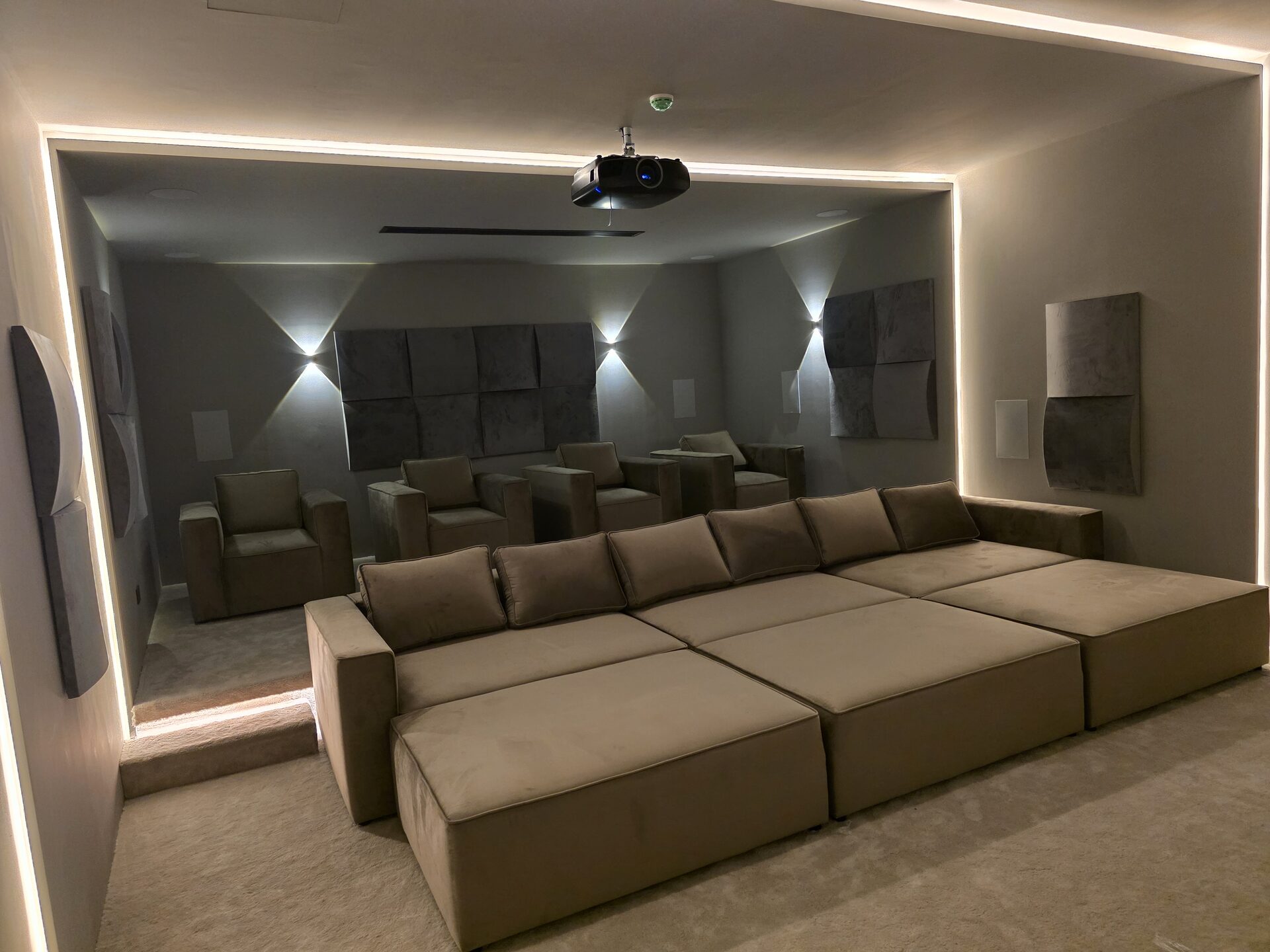
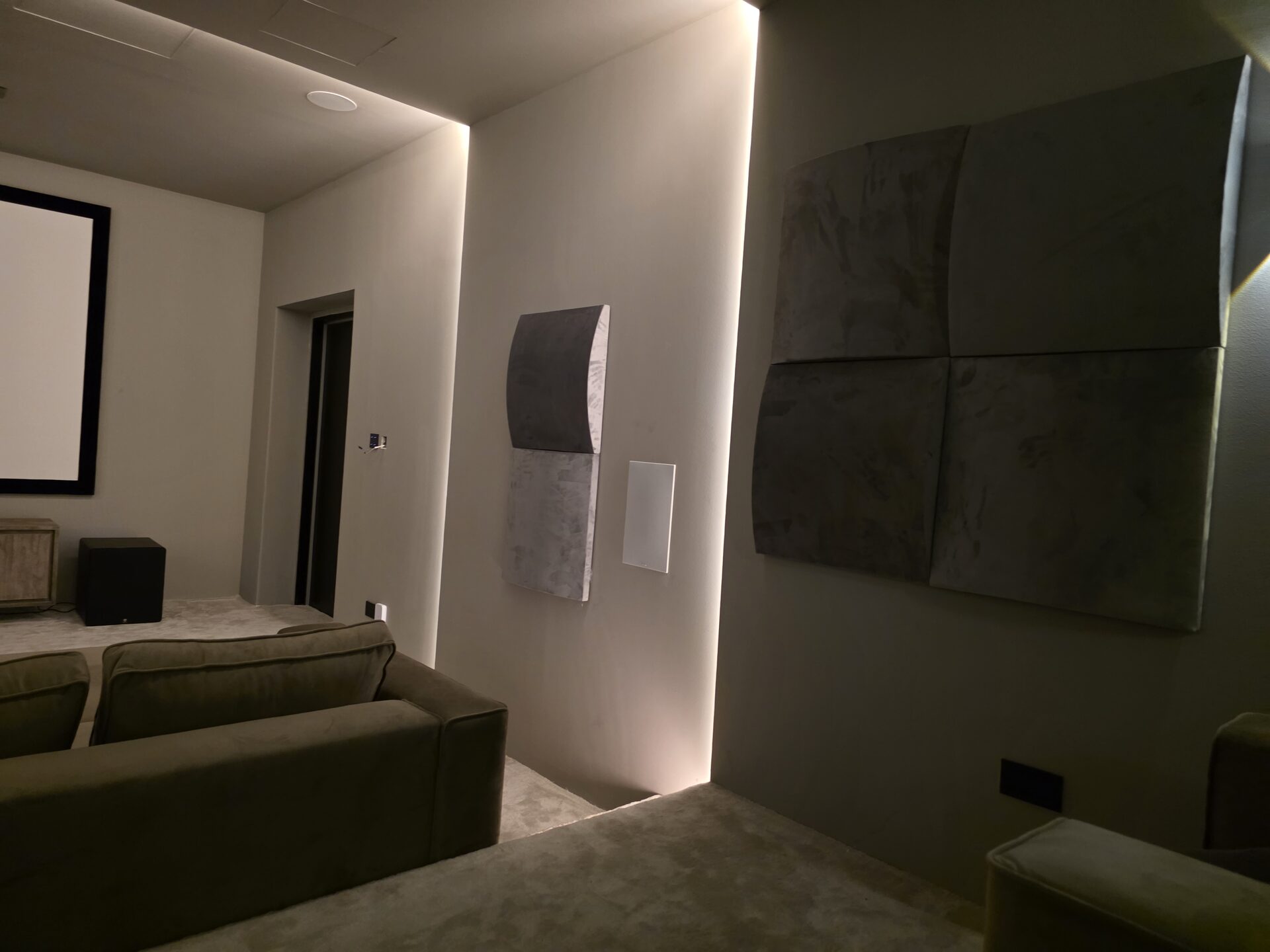
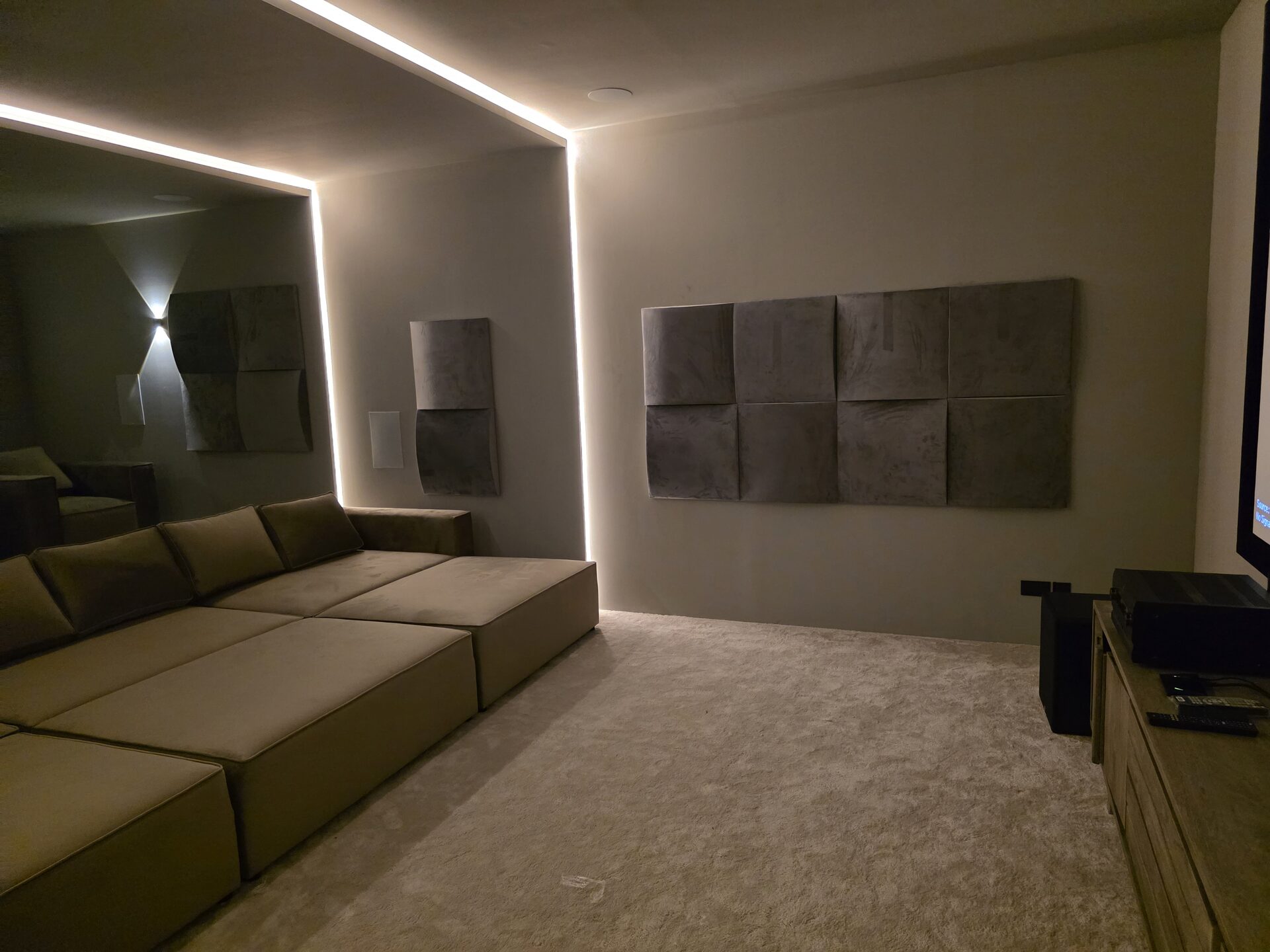
The best treatment is invisible. Absorption and diffusion can sit behind fabric walls, panelling and joinery, so the cinema looks like the rest of the house and still performs like a cinema.
Frequently asked questions
Is acoustic treatment the same as soundproofing?
No. Acoustic treatment controls how the room sounds inside; soundproofing, or isolation, controls how much sound gets out or in. They use different methods, and most dedicated cinemas need both.
Will acoustic panels stop sound leaking into other rooms?
No. Absorption panels improve the sound inside the room but do almost nothing for sound passing through the walls. Stopping leakage needs mass, decoupling, damping and airtight construction, especially around the door.
Why does the bass boom in one seat and disappear in another?
Room modes: standing waves set by the room's dimensions. They're fixed by proportion, seat and subwoofer placement, often multiple subwoofers, and proper low-frequency treatment, then measurement and correction, not by a bigger subwoofer.
Is room-correction software enough on its own?
No. It is valuable as the final step, but it can't remove early reflections or fill deep bass cancellations created by the room. It works best in a room that has already been treated.
Can treatment be added to an existing home cinema?
Usually, yes, without major works. Isolation is different: it's built into the walls, ceiling and floor, so it's far easier and cheaper to plan before the room is finished.
Hear what your room is doing
- Talk to an engineer: book a free 60-minute Private Cinema Design Session at your villa or over your plans online.
- Read before you brief anyone: get our free checklist, Before the ceiling closes, which covers keeping the sound in and air conditioning you can't hear.
- Planning the whole room? Start with the private cinema buyer's guide.